
This Hidden Heuristic Algorithm Is Quietly Controlling Your Marketing (And Most Marketers Don’t Know It)
- Satesh singh
- Jan 7
- 6 min read

Look, I'll be honest with you. A few years back, I had no clue what a heuristic algorithm was. I thought it was just another tech buzzword that developers threw around to sound smart. Then I realized something that changed how I approached digital marketing entirely.
Every single campaign decision I was making—from ad targeting to content recommendations—was being influenced by heuristic algorithms behind the scenes. And I wasn't even aware of it.
What Actually Is a Heuristic Algorithm?
A good heuristic algorithm is not an otherworldly, terrific AI. A heuristic algorithm is just a method for solving problems that produce "good enough" solutions in a very short time rather than in a very long time in order to reach the perfect solution to that same problem.
An example of how we use heuristic algorithms is when you order your food at 2 a.m.
Rather than do a three-hour search (reading reviews, looking at the menu prices of each restaurant in your area, and figuring out how long each restaurant's delivery time will be).
You choose a restaurant based on its availability, distance from your location, and its acceptable rating from other customers. This is heuristic thinking and using practical approaches to reach fast results.
In the world of digital marketing, we are inundated with tremendous amounts of information regarding our customers' activities, ad performance metrics, and social media statistics, etc. As a result, using heuristic algorithms to help identify trends in customer data is paramount!
How Heuristic Algorithm Powers Your Ad Campaigns
Let's talk Facebook Ads. Ever wondered how Facebook decides which 1,000 people see your ad out of millions of potential users? Spoiler alert: it's not checking every single user profile one by one.

A heuristic algorithm runs behind the scenes, making educated guesses based on patterns. It looks at who engaged with similar ads, who fits your target demographics, and who's most likely to convert. Then boom—your ad appears in their feed.
Similar to Google Ads, Google does not compute all of the possible bidding scenarios when you bid on keywords. However, Google does use its heuristic algorithm to create a calculation model based on the most successful ads through various algorithms.
The algorithm uses smart shortcuts to predict how well your ad will perform based on factors like ad quality, the amount you bid, and estimated clicks on your advertisement.
The beauty? These decisions happen in milliseconds. No human could process that fast.
Content Recommendation Engines Use Heuristic Algorithm Daily
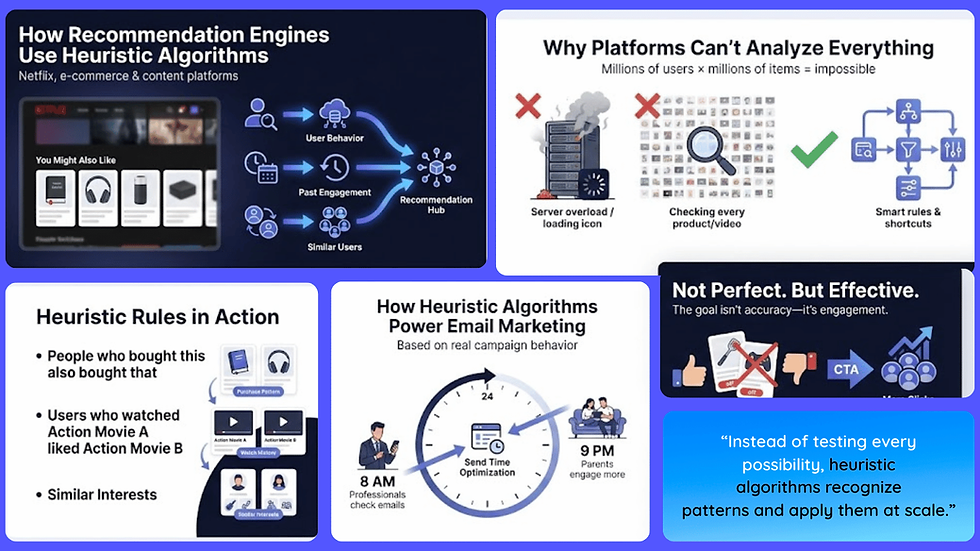
You know those "You Might Also Like" sections on e-commerce sites? Or Netflix suggesting your next binge-watch? That's heuristic algorithms at work.
These systems can't analyze every product or video in their database for every user. That would take forever and crash their servers. Instead, a heuristic algorithm applies rules like "people who bought this also bought that" or "users who watched Action Movie A loved Action Movie B."
It's not perfect. Sometimes you get weird recommendations. But it works well enough to keep you clicking, and that's what matters in digital marketing.
I've experienced email marketing campaigns firsthand. We rely on heuristic algorithms to decide when to send emails to our subscribers.
\Instead of testing all possible hours on each subscriber, the algorithm recognizes patterns such as "people in a professional setting check their email at 8 am," and "parents are more likely to engage after 9 pm." These established rules are then applied across many subscribers.
SEO and Heuristic Algorithm: The Hidden Connection
Here's something most SEO specialists don't openly discuss. Google's ranking algorithm? It's essentially a massive heuristic algorithm.
Because of the vast number of web pages available and the way Google indexes these billions of pages based on a user’s search query, they need to make heuristic assumptions. Rather than efficiently analysing every single attribute to determine page rank, Google has developed guidelines for how it determines the best web page for a given search term based on different types of signals that they believe represent the best content quality available, such as backlinks, page speed, content relevancy, and user interaction.
This was a moment that completely changed [my SweetSEO] approach to search engine optimisation.
Instead of being focused on examining each minute detail of ranking signals, I now pay attention to the major signals (quality content, quality backlinks, fast loading times, and positive user interaction) that Google is assigning the highest importance to when ranking web pages for a user’s search request.
Social Media Algorithms Rely on Heuristic Algorithm Logic
Instagram's feed isn't chronological anymore, and that frustrates a lot of marketers. But here's why it happened: Instagram uses a heuristic algorithm to predict which posts you'll engage with most.
It can't show you every single post from everyone you follow—that'd be information overload. So the algorithm applies rules: "Show posts from accounts they engage with frequently," "Prioritize recent posts," "Boost posts with high early engagement."

TikTok's For You page is perhaps the most sophisticated example. Their heuristic algorithm learns incredibly fast what type of content keeps you scrolling. It doesn't need to understand why you like a specific video—it just recognizes patterns in your behavior and serves similar content.
For marketers, this means understanding the heuristic rules these platforms use is more valuable than fighting against them. Create content that triggers engagement quickly. Encourage saves and shares. Build genuine interaction.
A/B Testing Gets Smarter with Heuristic Algorithm
Traditional A/B testing is slow. You split traffic 50-50, wait for statistical significance, then pick a winner. But modern platforms use heuristic algorithms to speed this up.
Multi-armed bandit testing is a perfect example. The heuristic algorithm doesn't wait for one clear winner. Instead, it gradually shifts more traffic to better-performing variations while still testing others. This "exploit versus explore" approach finds winners faster and wastes less traffic on poor performers.
I've used this in landing page optimization. Rather than running rigid tests for weeks, the heuristic algorithm identifies winning elements within days and automatically adjusts traffic distribution. It's not mathematically perfect, but it's practically superior.
Why Marketers Should Care About Heuristic Algorithm
Here's my honest take after years in digital marketing. You don't need to code a heuristic algorithm yourself. But understanding how they work gives you a massive competitive advantage.

When you know that ad platforms use heuristic shortcuts, you optimize for the signals they prioritize. When you understand social media algorithms rely on heuristic pattern recognition, you create content that triggers those patterns.
Most marketers treat algorithms like black boxes—mysterious forces that randomly determine success or failure. But when you recognize them as heuristic algorithms making practical, pattern-based decisions, you can work with them instead of against them.
The Future: Heuristic Algorithm Evolution in Marketing
With the help of AI and machine learning, heuristic algorithms are becoming more advanced in their ability to find quick solutions.
Learning faster, adapting more easily, and producing better results from less input; AI and ML have opened up many possibilities for marketers and businesses that use these types of algorithms as part of their business strategy.
As a result, there are two main areas where digital marketers will benefit from the continued development of AI and ML.
The first is that the platforms and tools we utilize as digital marketers will become increasingly intelligent in identifying what are "good enough" solutions and the second is that understanding the principles behind heuristic algorithms requires increased familiarity.
Marketers will prosper from having an understanding of the basic principles of heuristic algorithms which drive all digital marketing strategies. This understanding will allow them to create better strategies using heuristic algorithms.
At the end of the day, the decisions made by Google regarding the ranking of website pages, the placement of Facebook ads, and the recommendations of Netflix programming are all based on finding smarter and faster ways to accomplish those tasks. The best way to accomplish that is through the application of heuristic algorithms.
Ready to Work With Algorithms, Not Against Them?
Look, understanding heuristic algorithms is one thing. Actually implementing strategies that leverage them? That's where most businesses struggle.

If you're tired of throwing money at ads that don't convert or posting content that algorithms bury, maybe it's time for a different approach. Our team at Harnium doesn't just follow best practices—we understand the heuristic logic behind every platform and build campaigns that work with these systems naturally.
We've helped dozens of businesses crack the code on algorithm-driven marketing, from SEO that actually ranks to social content that platforms love to promote. No magic tricks. Just smart strategy based on how these systems actually think.
Want to chat about your marketing challenges? Let's see if we can find some practical shortcuts to get you better results.
Sources & References
1. Simon, H. A. (1957). :Models of Man, Social and Rational– Introduced the concept of heuristics and bounded rationality, which forms the foundation of modern heuristic algorithms.
2. Google Search Central – How Search Workshttps://developers.google.com/search/docs/fundamentals/how-search-works
3. Meta (Facebook) Ads – How Ad Auctions Workhttps://www.facebook.com/business/help/430291176997542
4. Netflix Tech Blog – Recommendation Algorithmshttps://netflixtechblog.com


Comments